
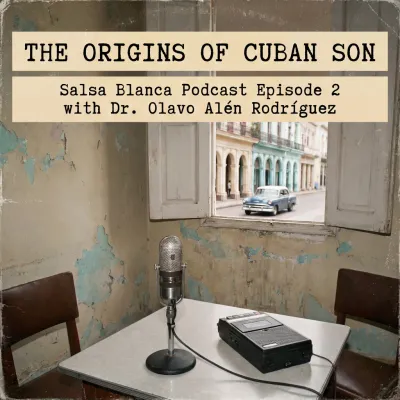
A Lecture with Olavo Alén Rodríguez in Havana, Cuba
Editor's Note: This transcript comes from an old class recording in Havana, Cuba, where musicologist Olavo Alén Rodríguez discusses the origins and evolution of cha-cha-chá. The audio quality was less than perfect, but the insights into Cuban musical history are invaluable. Transcription has been edited for clarity where possible.
Q: Do you think that it was because of the influence of American genres?
Rodríguez: Some think like that, I don't think so, I don't think so. Others think that it was a phenomena, a cure because when they started to play here on this middle section, pieces of classical music, famous songs or more recently from movies or something. You know, Singing in the Rain things, you could play any.
Dance to danzon which has "Stars and Stripes Forever," played by Aragon orchestra in the 50s. Because somebody, a visitor came from the states and— And the best point about that was that it wasn't easy to make another song because you simply took parts from different works and you put them together.
So what mainly, if you're playing a ballroom and you need to play a lot of danzon, you know you don't have time for writing. They composed eight bars for the introduction. So the B section was a multi-sonata and now this 8 bars again and now this was B concerta and so on. And this was the easy way of composing that song. That's what some musicians think. I'm not quite sure of that.
But anyway, what really happened is that above the 40s, up to the 50s, about 1956 or something like that, let's say up to the first half of the 50s, no longer danzon were played so much and cha-cha-chá was born. So we can say it's in the same line. Now cha-cha-cha, yeah?
Dance to danzon which has "Stars and Stripes Forever," played by Aragon orchestra in the 50s. Because somebody, a visitor came from the states and— And the best point about that was that it wasn't easy to make another song because you simply took parts from different works and you put them together.
So what mainly, if you're playing a ballroom and you need to play a lot of danzon, you know you don't have time for writing. They composed eight bars for the introduction. So the B section was a multi-sonata and now this 8 bars again and now this was B concerta and so on. And this was the easy way of composing that song. That's what some musicians think. I'm not quite sure of that.
But anyway, what really happened is that above the 40s, up to the 50s, about 1956 or something like that, let's say up to the first half of the 50s, no longer danzon were played so much and cha-cha-chá was born. So we can say it's in the same line. Now cha-cha-cha, yeah?
Q: You know with danzon, especially in this charanga francesa instrumentation it sounds so gentile. Charanga genres that were orchestrated in real life, danzon was orchestrated in 19th century. It is somewhat old fashioned and so antique and so gentile. It seems to me historically that it's from another time—
Rodríguez: Yes it is.
Q: It has feudal overtones.
Rodríguez: Yeah that's right.
Q: So did you say that cha-cha-chá came out just from danzon?
Rodríguez: No. No, because look charanga francesa is an orchestra, danzon is a style of music. We've been talking about different themes here. But not exactly is a result of danzon, what I mean is of the same line, you know. That's why we played them on the same crew.
Cha-cha-chá was born when danzon died, something like that. And it was played by the same orchestra which is the name of Orchestra Charanga Francesa. So that's why, it came about as a result—
Cha-cha-chá was born when danzon died, something like that. And it was played by the same orchestra which is the name of Orchestra Charanga Francesa. So that's why, it came about as a result—
Q: Do you know how the word charanga came?
Rodríguez: Yes, I'll walk you down there. Charanga and pachanga— Charanga, these are two words I think, in the average line anyway what it's supposed to mean, charanga is the way of playing and dancing and dancing music. And pachanga was the party.
So if somebody says I'm going to make a pachanga it means he's going to make a party where a charanga is playing pachanga and so on. So and some thing like that, it's very complicated. It's very complicated. But anyway, that's the name.
In French, most musicians don't agree but why French? Nobody knows exactly. There are some opinions I have read in some books, why French? Maybe because of the contradanza. It changed directly from contradanza which came from French influence. Maybe that's the reason why charanga and francesa, maybe in Cuba anything can happen, maybe because it was so gentile they called French you know perfume and… anything can happen. Yes.
So if somebody says I'm going to make a pachanga it means he's going to make a party where a charanga is playing pachanga and so on. So and some thing like that, it's very complicated. It's very complicated. But anyway, that's the name.
In French, most musicians don't agree but why French? Nobody knows exactly. There are some opinions I have read in some books, why French? Maybe because of the contradanza. It changed directly from contradanza which came from French influence. Maybe that's the reason why charanga and francesa, maybe in Cuba anything can happen, maybe because it was so gentile they called French you know perfume and… anything can happen. Yes.
Q: Who did play at the orchestra son montuno 'cause that was done by the peasants and danzon was for the upper class—
Rodríguez: Exactly.
Q: When did that happen?
Rodríguez: No, it had from the very beginning. It's very interesting. That's a very interesting question because yes, you see that's the thing about Cuban culture. It's such a big mix.
Nobody expects that some style of music can bond with a musical form and with the mix of different social elements and environment. Even more further than that in this question, you're asking if we go further on, no there were even racial differences.
Not only, I mean, we were speaking about a time where the Negroes were not allowed in the saloon, you know where white people were clients. Can you imagine that? Most of the people who played danzon were mulattoes.
So how did that happen, nobody knows. It's Cuba you know, it's just— It's very funny, it is. But that's interesting because it's a rare example.
Now I'm trying to go to cha-cha-chá and no more questions here?
Nobody expects that some style of music can bond with a musical form and with the mix of different social elements and environment. Even more further than that in this question, you're asking if we go further on, no there were even racial differences.
Not only, I mean, we were speaking about a time where the Negroes were not allowed in the saloon, you know where white people were clients. Can you imagine that? Most of the people who played danzon were mulattoes.
So how did that happen, nobody knows. It's Cuba you know, it's just— It's very funny, it is. But that's interesting because it's a rare example.
Now I'm trying to go to cha-cha-chá and no more questions here?
[Professor speaks briefly in Spanish, then continues...]
Rodríguez: Okay so cha-cha-cha. I want you to hear an example of cha-cha-cha but first I think you'll be happy with the first cha-cha-cha written by Enrique Jorrin.
I want you to feel the similarity to danzon. There was a development of danzon, a last development which is considered the ending of danzon which was danzonete. Also born in Matanzas, they are very proud of their music, danzonete which means a slighter, smaller form of danzon.
Danzonete, as everything in Cuba, this is a French word. You know danzonete. And danzonete was mainly the same danzon but the difference was that they included a singer in the center section, a singer.
And son montuno, they made it, I mean they shortened it, the whole danzon, and made a bigger C and a bigger D so son montuno. Also the son montuno had a different style of making music. Let's hear, you can hear where— Not many danzonetes were composed, so basically most of musicians considered this was the final, the end of danzon.
I want you to feel the similarity to danzon. There was a development of danzon, a last development which is considered the ending of danzon which was danzonete. Also born in Matanzas, they are very proud of their music, danzonete which means a slighter, smaller form of danzon.
Danzonete, as everything in Cuba, this is a French word. You know danzonete. And danzonete was mainly the same danzon but the difference was that they included a singer in the center section, a singer.
And son montuno, they made it, I mean they shortened it, the whole danzon, and made a bigger C and a bigger D so son montuno. Also the son montuno had a different style of making music. Let's hear, you can hear where— Not many danzonetes were composed, so basically most of musicians considered this was the final, the end of danzon.
Q: What year is this?
Rodríguez: 1929. Was the first danzonete by Aniceto Diaz. Composer Aniceto Diaz. That's how we play nowadays the charanga. Okay, now I think that, yes—
Q: 1929? The recording's from 1929?
Rodríguez: No I don't know if the recording is 1929. No, I don't know. I know the recording is a very old one but I'm not sure, the date is not written on the recording. But the music was from 1921.
[Recording plays: danzonete]
Rodríguez: Now let's listen to cha-cha-cha okay, I think it's clear. When you hear separately, you can't really tell. But when you hear together, it's the same orchestra. It's the same instruments. This is just a verse cha-cha-chá 1951, first cha-cha-cha "La Engañadora" by Enrique Jorrin.
Q: But that's 20 years—
Rodríguez: Second section excuse me. So introduction, 2nd verse, but it's no longer so clear. So a 20 year timespan between the last danzon and cha-cha-chá. But danzones were very played up to the 40's. There was about 20 years where danzones weren't played until the first of… That means 1941 to 1961 it was just about.
[Recording continues playing different sections]
Rodríguez: So we have another section here. So if you hear, danzon is still somewhere there. And you'll hear son montuno, very cool. A section again. Now, son montuno. "La Engañadora," the words, the lyrics are very funny. A lady who uses, you know she wants to make believe that she's— She puts herself as a, I don't know how you say it—
Q: Star.
Rodríguez: And she used to go to Prado and [unclear] streets where everybody, all the men were on the corner, you know what I mean. Walked in front of everybody and somehow somebody discovered the secret and that's why la engañadora means, engaño is—
Q: [All] Deceiver.
Rodríguez: The deceiver, that's right, engañadora. And nobody believes her any more, the engañadora, because everybody knew them.
I think [it's time for] another cha-cha-cha. Because there is a final attempt that I want you to hear. Emiliano Salvador. Playing contradanza in a modern way. So this is a nice example because it brings the entire history back to the very beginning. Played by a very famous jazz pianist. He died very young. I think he was a genius. Emiliano Salvador.
I think [it's time for] another cha-cha-cha. Because there is a final attempt that I want you to hear. Emiliano Salvador. Playing contradanza in a modern way. So this is a nice example because it brings the entire history back to the very beginning. Played by a very famous jazz pianist. He died very young. I think he was a genius. Emiliano Salvador.
Q: He lives in Cancun?
Rodríguez: No, no, he died.
Okay so, I think we did it because I wasn't expecting to have time to…
Okay so, I think we did it because I wasn't expecting to have time to…
[End of recording]