
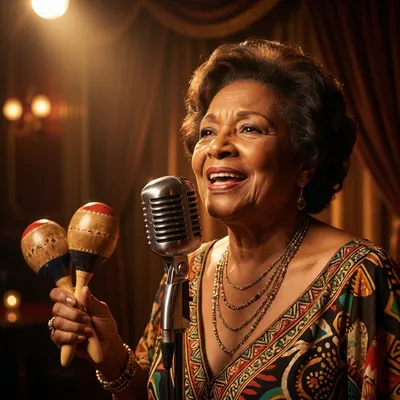
In the pantheon of Cuban music, few figures bridge the gap between the traditional distinctiveness of the mid-20th century and the global world music boom of the late 1990s as seamlessly as Teresa "Teté" García Caturla. A woman possessed of grace and her own personality, known for her exact phrasing and an enviable rhythmic sense, Caturla's career spanned over half a century. From the small town of Remedios to the Royal Festival Hall in London and the Hollywood Bowl in Los Angeles, her journey was one of relentless dedication to the art form she inherited from one of Cuba's most legendary musical families.
If you know anything about the Buena Vista Social Club, you've probably heard Omara Portuondo's name. But there's a good chance you haven't heard of the woman who stood beside Omara in one of the most important vocal groups Cuba ever produced — and who kept that group alive for decades after its founder died. Everybody called her Teté, and this is her story.
Born Into It: The Early Years in Remedios
Teté was born on October 13, 1937, in Remedios, a small colonial city in Villa Clara province. Remedios is one of the oldest towns in Cuba — famous for its spectacular Christmas fireworks (parrandas) — and it has always punched above its weight culturally. But even by Remedios standards, the García Caturla family was something special.
Her father was Alejandro García Caturla, one of the towering figures of 20th-century Cuban composition. Alejandro wasn't just any musician — he was a revolutionary one. In the 1920s and 1930s, alongside his contemporary Amadeo Roldán, he pioneered Afrocubanismo, the nationalist musical movement that fused Afro-Cuban rhythms and folklore with European classical forms. He studied in Paris under the legendary Nadia Boulanger — the same teacher who shaped Aaron Copland and Quincy Jones. He was also a violinist, orchestra conductor, practicing lawyer, and judge — a man of fierce principle who consistently defended the rights of workers and the poor. That courage cost him his life: in 1940, at only 34 years old, he was assassinated by a criminal he was about to sentence in his hometown of Remedios. Teté was just three.
So the music was in her blood, but it came shadowed by loss. Growing up in her father's town, surrounded by his legacy, Teté started performing at a very early age. She joined the Banda Infantil (Children's Band) in Remedios under maestro Agustín Jiménez Crespo, then studied formally at the Municipal Academy of Music. She was a good student all around — she completed her studies at the Escuela Normal and qualified as a teacher. It was a respectable path, yet the pull of her heritage and her own talent was too strong to ignore. Ultimately, she decided to dedicate herself entirely to music, a decision that would enrich Cuban culture for decades to come.
1958: Havana Calling
In 1958, Teté made the move that every ambitious Cuban musician had to make — she left the provincial atmosphere of Remedios for Havana, the epicenter of Caribbean nightlife and musical innovation. The timing was extraordinary. This was the final year before the Revolution, when Havana's music scene was vibrant, fiercely competitive, and legendary. If you could cut it there, you could cut it anywhere.
Teté could cut it. She debuted professionally with Orquesta Anacaona (sometimes called Las Anacaonas), the pioneering all-female orchestra that had been breaking gender barriers in Cuban music since the 1930s. Performing with Anacaona was a significant achievement — the group was a genuine institution — and for Teté, it served as a springboard into the upper echelons of Havana's entertainment circuit.
The Cuarteto D'Aida: Where Legends Stood Together
But the real story of Teté's career begins in 1963, when she joined the Cuarteto D'Aida.
If you're not familiar with this group, here's what you need to know: the Cuarteto D'Aida was one of the most important vocal ensembles in Cuban history. Period. Founded in 1952 by the pianist Aida Diestro, the original lineup featured Elena Burke, Moraima Secada, and the sisters Omara and Haydée Portuondo. These women rose from poverty — they reportedly wore homemade clothes to their first television appearances — and became stars. The quartet was central to the filín (feeling) movement, a post-war Cuban style deeply influenced by jazz harmonics and intimate vocal delivery. They could sing a bolero that would break your heart, flip into a guaracha that would get the whole room moving, and handle sophisticated close-harmony arrangements that would impress any jazz vocalist. They performed everywhere that mattered in Havana — the Tropicana, the Sans Souci — and shared stages with Nat King Cole, Bebo Valdés, and Chico O'Farrill. They toured internationally before and after the Revolution.
By the time Teté joined in 1963, the original members had mostly moved on to solo careers. She stepped in alongside Omara Portuondo, Xiomara Valdés, and Lilita Peñalver, taking her place as the "fourth voice" in a lineup that is now considered legendary. This period marked the true commencement of her professional life at the highest level. With the Quartet, Teté recorded albums and became a fixture at the most important venues in Cuba: the world-famous Tropicana, the Cabaret Parisién, the Cabaret Caribe, and the stages of the luxury Hotel Capri and Hotel Riviera. They were regulars on important programs of Cuban radio and television.
For musicians and music lovers, the D'Aida repertoire is essentially a master class in mid-century Cuban composition. They performed works by titans such as César Portillo de la Luz, José Antonio Méndez, Pepé Delgado, Adolfo Guzmán, Eliseo Grenet, Ernesto Lecuona, Armando Oréfiche, René Touzet, Orlando de la Rosa, and Rafael Hernández. These weren't just popular songs — they were the works of composers who were reshaping how Cuban music sounded, harmonically and lyrically. To sing this material well required not just a good voice but serious musical intelligence: precise intonation, an intuitive feel for clave, and the ability to blend within tight vocal harmony while maintaining individual character. Teté was praised specifically for her exact phrasing and enviable rhythmic sense — qualities that are easy to name but murderously hard to achieve.
Taking the Reins (1973–1998)
In October 1973, Aida Diestro died. She was not yet 49. The loss was devastating — Aida was the musical brain of the operation, the arranger and pianist who held the quartet's complex harmonics together. Teté herself later acknowledged that Aida had been crucial to her artistic development.
But the music didn't stop. The mantle of leadership fell to Teresa. She assumed the direction of the group, joined in this endeavor by her brother, Ramón García Caturla, who was himself an accomplished orchestral conductor and arranger. Under their direction, the Cuarteto D'Aida did not falter. They continued to harvest successes both on the island and outside of it, maintaining a select repertoire that encompassed the best of Cuban music.
This era was defined by extensive international touring: Panama in 1978, Grenada in 1979, Mexico in 1983, Spain in 1984, Angola in 1986, Finland in 1987, and later Argentina, France, and Peru. The group finally dissolved in 1998, a full quarter-century after its founder's death — a remarkable run by any standard. By the time the curtain came down, the Cuarteto D'Aida had been a working institution for 46 years. Teté had been part of it for 35 of those years, leading it for 25.
Running With Giants: Estrellas de Areito
During the 1980s, while still leading the Quartet, Teté expanded her artistic footprint by joining the Estrellas de Areito (Areito Stars). This ensemble was a gathering of the old guard, a constellation of stellar figures that recorded and performed with great success, particularly in Venezuela.
Her involvement placed her shoulder-to-shoulder with classic voices and instrumentalists who defined Cuban music. The roster reads like a hall of fame: vocalists Tito Gómez, Miguelito Cuní, and Pío Leyva; instrumentalists Enrique Jorrín (the man who created the cha-cha-chá), Rafael Lay, Richard Egües, Félix Chapotín, Rubén González, Cachaíto López, Amadito Valdés, and Tata Güines. The trumpeter Arturo Sandoval also performed with the ensemble.
For anyone keeping score at home, that roster is staggering. These were the people who invented genres, who defined the sound of Cuba for the world. And Teté held her own among all of them — not as a curiosity or a token, but as a peer. The experience solidified her reputation not just as a quartet singer, but as a versatile vocalist capable of standing out among the greatest soloists and improvisers of her generation.
The Global Revival: Afro-Cuban All Stars and Buena Vista
As the 1990s drew to a close, Cuban music experienced an unprecedented explosion of global interest. The Buena Vista Social Club album, produced by Ry Cooder and released in 1997, along with Wim Wenders' 1999 documentary, ignited a worldwide passion for traditional Cuban music. Suddenly, the world was paying attention to the same musicians Cuba had known about for decades.
True to her history of being at the center of musical excellence, Teté was a key participant in this revival. Starting in the spring of 1998, she joined the Afro-Cuban All Stars as a soloist, performing at major world music and jazz festivals across Europe: the Swinging Groningen Festival in Holland, the Paleo Festival in Switzerland, the Masala Festival in Germany. She toured North America extensively, and her voice resonated in the Conga Room in Los Angeles, the Hollywood Bowl, the Lisner Auditorium in Washington D.C., Town Hall in New York, Massey Hall in Toronto, and Le Spectrum in Montreal. She performed at the Royal Festival Hall in London.
During these years, she also contributed as a guest soloist on recordings linked to the Buena Vista Social Club project, reuniting her with her old friend from the D'Aida days, Omara Portuondo, as well as the bolero star Ibrahim Ferrer. It was a full-circle moment: the daughter of one of Cuba's first musical revolutionaries was now part of the movement that brought Cuban music to a new global audience.
Llegó Teté: A Long-Overdue Solo Debut
Here's a striking fact: after four decades of professional performance and countless recordings with other groups, Teté didn't release a solo album until 2003. Appropriately titled Llegó Teté ("Teté Has Arrived"), the album was a declaration of her individual artistry, released to celebrate 40 years of professional life.
It was worth the wait. Critics called it an exquisite phonogram, and its quality was formally recognized when it won the Gran Premio Cubadisco in 2004, one of the highest honors in the Cuban music industry. The album is a fine entry point for anyone looking to hear what made her special: a warm, rich voice with a distinctive timbre, impeccable phrasing, and that deep rhythmic sense rooted in decades of performing Cuban music at the highest level.
Never Stopping
Following the success of her album, Teté did not slow down. She continued performing in Cuba and touring the world. Ever the innovator, she formed a new group called Rumba Tere, made up of young graduates from Cuban music schools — a gesture that said a lot about who she was. Not just a performer preserving the past, but a mentor investing in the future. She continued performing as part of the Buena Vista Social Club constellation, and in 2015, she appeared in Playing for Change's "Chan Chan — Song Around the World" video, singing on a Havana balcony.
People who met her describe someone charismatic and playful. The filmmaker behind the documentary Cuba My Soul remembered her generosity in opening her home for interviews, and noted a signature move: she'd toss her maracas to an unsuspecting audience member mid-performance and make them keep up. That's the kind of thing you can only do if you own the stage completely.
The Final Bow
Teresa García Caturla's career extended for more than fifty years on the stages. She was described as authentically Cuban, a woman who possessed a timbre of her own and a versatility that allowed her to navigate between intimate quartets and massive orchestras. Her contributions to the nation were recognized with numerous decorations, including the Distinction for National Culture and the Replica of the Machete of Máximo Gómez.
Teté Caturla passed away in Havana on September 4, 2023, at the age of 85. Her death marked the end of an era, yet her legacy remains preserved in her recordings and the history of the ensembles she led and elevated. As noted by the Cuban Institute of Music upon her passing, she was indeed a Golden Voice of Cuban music.
From the municipal band of Remedios to the grandest halls of Europe and America, Teté's journey was defined by a commitment to excellence and a deep love for the rhythms of her homeland. She remains a towering figure in the story of Cuban music.
Listen: Llegó Teté (2003) is available on streaming platforms and is the best starting point for her solo work. For ensemble work, look for Estrellas de Areito recordings and Cuarteto D'Aida compilations. Her appearance in Playing for Change's "Chan Chan" video is available online.
Selected Discography:
- Llegó Teté (2003) — Winner of Gran Premio Cubadisco 2004
- Estrellas de Areíto
- Omara, la novia del feeling (with Omara Portuondo and Pío Leyva)
- Habana Night (with Celeste Mendoza, Tito Gómez, Caridad Cuervo, Ela Calvo)
Read More: For the full story of her father, see Charles W. White, Alejandro García Caturla: A Cuban Composer in the Twentieth Century (Scarecrow Press, 2003).
Musical Family:
- Alejandro García Caturla (Father): Composer, orchestra conductor, violinist, lawyer, judge (1906–1940)
- Ramón García Caturla (Brother): Orchestra conductor, arranger
- Genaro García Caturla (Brother)