Among the many instruments that shape the distinctive sound of Cuban music, few carry as much historical and ritual weight as the ekón: a clapper-less iron bell whose roots stretch across West and Central Africa and whose resonance echoes through centuries of diaspora, secrecy, and ceremony.
What Is the Ekón?
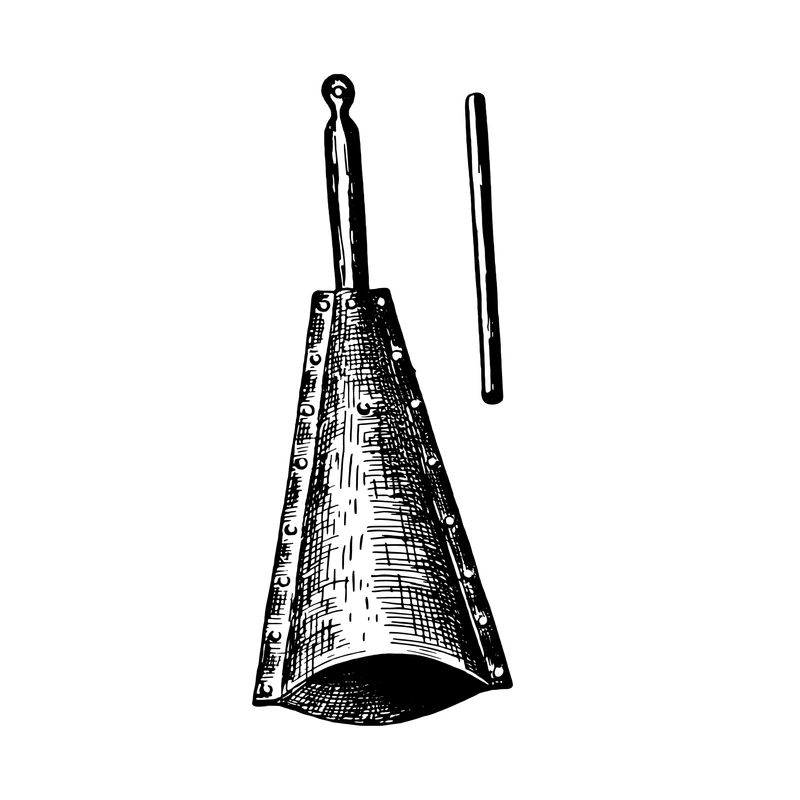
The ekón is a metallic, idiophonic percussion instrument made from two triangular iron plates welded along their sides, leaving one end open to form a lenticular (lens-shaped) cavity. The player holds it by a handle at the apex and strikes it with a small wooden stick. It is not a cowbell, a common misconception. A cowbell has a clapper suspended inside; the ekón has no tongue and is struck externally.
Fernando Ortiz, the Cuban ethnologist whose monumental Los instrumentos de la música afrocubana (1952-1955) remains the definitive study of the subject, was emphatic on this point. As he notes, the similarity of the ekón's exterior shape to a bell led organographers to classify it alongside bells, but the instrument deserves its own category entirely.
African Origins
The ekón is unquestionably African in origin. Across the west coast of Africa it appears under many names and in many forms. Among the Efik people of the Calabar region, founders of the secret ñañiguismo society, the word ekón means war, and its root, ñkon, derives from the verb koñ, meaning to strike a sharp, dry blow, like a hammer. The instrument was brought into Ñáñiga music, according to tradition, by initiates from the land of Mutanga.
Variants of this instrument appear across an enormous geographic range. In Dahomey (present-day Benin), it is known as the ogán, oggán, or kpanlingán; in the Congo, as the ngóngui; in Angola, as the engonguí; among the Hausa of the Niger region, as kuge. Among the Ivory Coast's Baoulé people it is the lauré. Double-bell versions have been documented from the Sudanese Hausas all the way south to Angola, and double iron bells have even been found among the ruins of Great Zimbabwe.
Ortiz proposed three main Cuban typological categories for these instruments:
- Ekón: the single-bell form, typical of Carabalí and Abakuá traditions
- Oggán: a wider, flatter variant used by Dahomeyan (Arará) communities
- Kangá: the double-bell form (jimaguas, or twins), associated with Lucumí, Arará, Iyesá, and Yebú communities
The Ekón and Abakuá Secret Societies
To understand the ekón's place in Cuba, one must understand the Abakuá brotherhoods, the only African secret societies to have been transplanted to the Americas following an African institutional model. Originating from the same Calabar coastal area as the Carabalí cabildos, these exclusively male organizations were rooted in Ibibio mask societies. They practiced cults centered on ancestors and divination, and in Africa had organized trading networks, including, historically, the slave trade, with European merchants operating out of Calabar City (Mirabeau, Cabildos de nation carabalí en Santiago de Cuba).
Among the Abakuá in Cuba, the ekón is the instrument par excellence of ritual authority. It is used to summon the Ékue, the mysterious, awe-inspiring entity at the heart of Ñáñiga cosmology, and to call forth the íreme, the masked spirit-figures (sometimes called "diablitos") who appear during ceremonies. Crucially, it is the only metal instrument permitted to enter the fambá, the sacred temple space.
Ortiz draws a compelling parallel between the ekón and the Egyptian sistrum: both are iron instruments used liturgically, both are believed to call spirits and ward off evil, and both carry deep symbolic weight in cosmologies that view iron as a sacred, even magical substance. Among many African peoples, iron was the primordial material, born of fire, earth, and wind, and those who worked it were considered to possess supernatural powers. The sound of iron was the voice of the ancestral world.
Across the Diaspora: Haiti and the Ogán/Trián
The ekón's journey did not stop at Cuba. In Haiti, a bell called the ogán was used in Vodou ceremony, closely related to the African ekón, though this use has gradually declined over time. The player of the ogán is known as the oganteyé.
In Haitian communities that settled in Cuba, a related idiophone survives under the name trián (or triyang): a flat metallic piece struck with a stick. The name likely derives from the triangle (triángulo), a similar idiophone that was widely used in Haitian popular music. In Haitian-Cuban musical traditions, the trián performs a rhythmic figure around which the entire polyrhythm of the ensemble is articulated, a role that closely mirrors the structural function of the ekón in Ñáñiga and Abakuá music (Mirabeau, Musical and dance traditions of Haitian communities in Cuba).
This parallel is telling. Whether called ekón, ogán, or trián, the iron bell in Afro-diasporic music almost always serves as a rhythmic anchor: the fixed point around which more fluid and improvisatory elements of the ensemble revolve.
Sound and Language
The ekón is not merely a timekeeper. In Abakuá ritual, it functions as a coded language. Ortiz documented a system of rhythmic signals used by the ekonista to communicate with the íreme:
- A single closed stroke (kon) = a greeting
- Two quick closed strokes (ko-kó) = go away
- Ko-kokokó-kokín = come here
- Kokín-kokin-ko-kokó = dance
- Kokokokín-kokokokín, rapid and insistent = warning, danger
Slow, grave strokes signal solemnity and mystery; rapid, high strokes signal celebration. The system is telegraphic rather than phonetic, closer in logic to Morse code than to speech.
The instrument also produces two distinct pitches depending on where it is struck: hitting the wider lower end produces one note, striking nearer the handle produces another. This bitonality is central to its rhythmic vocabulary and to the layered polyrhythm of Ñáñiga and Iyesá ensembles, where two ekónes may play together, combining their contrasting notes in interlocking patterns.
A Note About the Cencerro (Cowbell)
Ortiz was careful to distinguish the ekón from the cencerro, insisting that a cencerro is a complete bell with an internal clapper — which is true of the traditional European cowbell the name derives from. But the cencerro as it developed in Cuban popular music tells a more complicated story. By the time it became a fixture in son, salsa, and timba orchestras, the Cuban cencerro was itself clapper-less and struck externally: organologically much closer to the ekón than to any livestock bell. The name stuck, but the instrument had quietly transformed. In a sense, the ekón shed its ritual identity, acquired a more familiar label, and landed in the popular orchestra doing exactly the same job it had always done: holding down the rhythmic timeline for everyone else. The sacred became secular, but the function remained.
From Sacred to Popular
Today the ekón has traveled well beyond the ritual spaces of the fambá. Single and double ekónes are now standard fixtures in orquestas típicas, street ensembles, and Afro-Cuban folkloric groups, where their metallic brightness cuts through percussion and winds to mark rhythm for dancers and audiences alike. Ortiz noted this transition: instruments once carefully concealed from the uninitiated are now openly displayed as markers of Cuban cultural identity and, occasionally, as exotic attractions for tourists.
But the instrument's sacred origins are never entirely absent. When the ekón sounds slowly, gravely, in the ceremonial dark of an Abakuá rite, it is still calling across a very old boundary: between the living and the dead, between this world and the one that iron was always said to reach.
Further Reading
- Ortiz, Fernando. Los instrumentos de la música afrocubana. La Habana: Publicaciones de la Dirección de Cultura del Ministerio de Educación, 1952-1955.
- Mirabeau, Daniel. Musical and dance traditions of Haitian communities in Cuba.
- Mirabeau, Daniel. The Cabildos Carabalí in Santiago de Cuba. 2014 (version 3, revised 04/12/2019).
Tags: ekón, Abakuá, Afro-Cuban music, idiophones, iron bell, ñañiguismo, ogán, trián, Haiti, ethnomusicology, Fernando Ortiz